
Beyond the Shutter: How AI-Enhanced Post-Production is Revolutionizing E-commerce Visuals in Singapore
A quiet shift in how Singapore studios deliver product photography — faster turnaround, tighter consistency, lower cost per SKU.
May 13, 2026 • gradepixel

For most Singapore e-commerce brands, the bottleneck in product photography has never really been the shoot itself. The camera click is the easy part. The real cost — in time, money, and patience — sits in everything that happens after the shutter closes.
Background removal, colour correction, blemish cleanup, shadow work, resizing for marketplaces, ensuring every product in a 200-SKU drop looks like it belongs to the same family. That’s where weeks disappear.
A quiet shift is happening in studios across the island. AI-enhanced post-production isn’t replacing photographers — it’s reshaping the workflow that surrounds them. And for e-commerce brands shipping new SKUs every week, the impact is significant.
01 — The Bottleneck
The traditional workflow problem
A typical product shoot for an apparel or beauty brand follows a familiar arc: half a day shooting 50 SKUs, then two to three weeks of post-production. Each image passes through a retoucher who clips backgrounds, balances colour, removes dust and lint, evens out skin tones on model shots, and exports for Shopify, Lazada, Shopee, and Instagram in different aspect ratios.
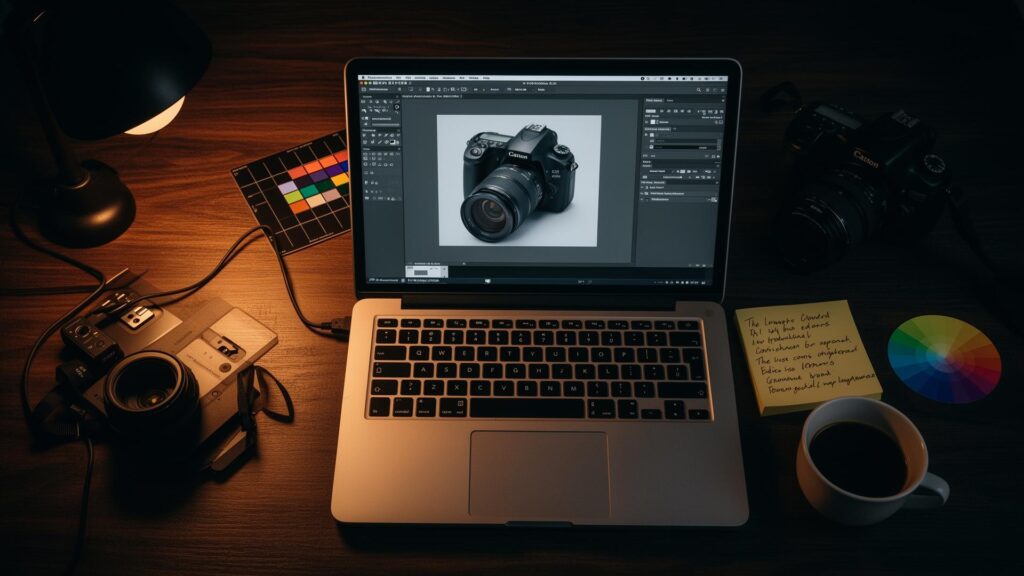
Multiply that across a seasonal catalogue and the maths gets uncomfortable:
- Cost per image sits anywhere from S$15 to S$35 depending on complexity.
- Turnaround stretches campaigns and delays go-live dates.
- Consistency drifts when multiple retouchers split the batch — slight differences in white balance, crop, or shadow density.
- Revisions compound — every “can we make image 47 a touch warmer?” means re-opening files, re-exporting, re-uploading.
…
Speed to listing
- New product photographed Monday, live by Thursday.
- Reshapes how brands plan launches and restocks.
- Seasonal drops without the multi-week tail.
Batch consistency at scale
- Reference-frame colour matching across the set.
- No drift between retouchers working in parallel.
- Cleaner grids on PDPs and category pages.
Lower cost per SKU
- S$55 per image budgets often drop to S$15–S$35.
- Frees budget for variants and lifestyle content.
- Makes long-tail SKU photography economical.
Faster iteration
- Re-export the entire set in an afternoon.
- Test backgrounds, crops, and aspect ratios quickly.
- Campaign pivots without restarting post.
04 — The Limits
What AI doesn’t do (and probably shouldn’t)

It’s worth being honest about the limits, because the hype around generative AI has muddied the conversation.
- AI doesn’t replace the photographer. Lighting a glossy bottle so it doesn’t blow out the highlights, directing a model to feel natural in a static pose, knowing when to break the brand guideline for a stronger image — that’s craft, and it stays human.
- AI doesn’t invent products. For real e-commerce, the customer expects the box to look like the photo. The product still needs to be physically photographed.
- AI doesn’t define a brand’s visual identity. It executes within a defined system. Someone still has to define the system.
- AI gets things wrong. Edge detection fails on certain materials. Colour matching can over-correct. That’s why a human retoucher reviews every batch before it ships.
05 — The Industry Shift
Where this leaves Singapore studios
Studios in Singapore are quietly restructuring around this hybrid model. The ones that adapt are offering faster turnaround, more competitive pricing, and — perhaps most importantly — taking on volumes of work that were previously uneconomical for both sides.
The ones that don’t are increasingly competing on craft alone, which is fine for editorial and brand campaigns, but a hard sell when the brief is “300 SKUs, marketplace-ready, by next week.”
For e-commerce brands, the practical question isn’t whether to work with an AI-enhanced studio. It’s whether your current production partner is structured to deliver at the speed and consistency your storefront actually needs.
Ready to shoot?
Let’s talk through your catalogue.
If you’re a Singapore brand with a clear product, a clear shot list, and a launch deadline that’s making you nervous — the hybrid workflow exists precisely for you. We’ll walk through what your specific catalogue would look like under this approach, including realistic timelines and per-image costs.
A title
Image Box text
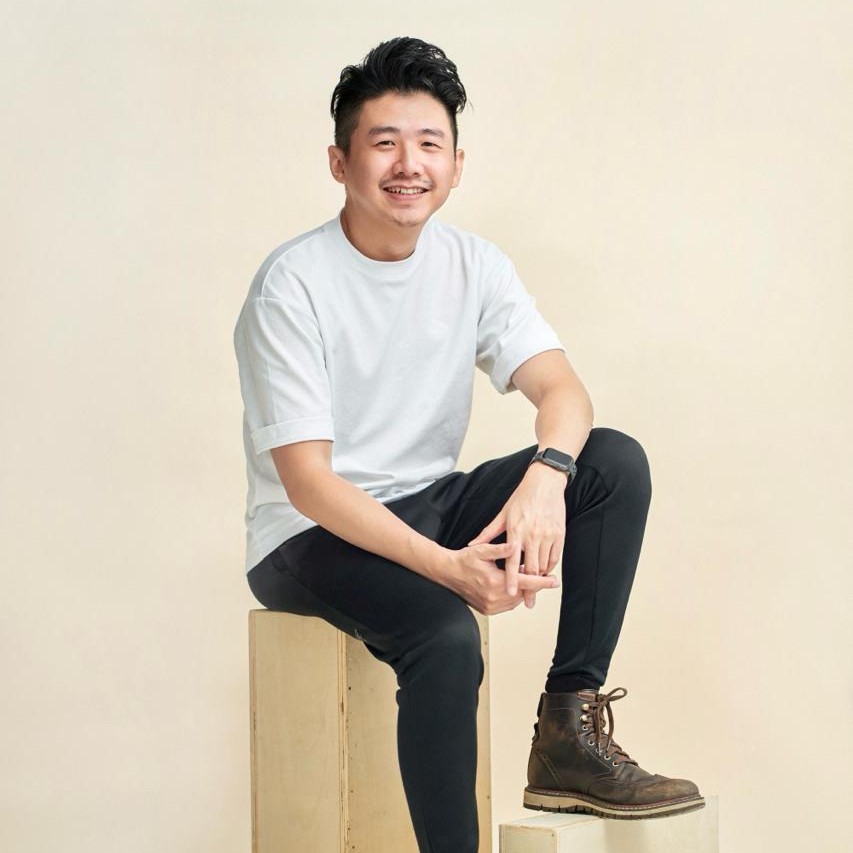
Sylvester Lim - Founder of GradePixel
I’m Sylvester, founder of GradePixel, a commercial photography and video production studio in Singapore with over 10 years of experience. I’ve worked with brands across product, food, fashion, and corporate sectors, helping businesses create clean, effective visuals that drive real results. My focus is always on practical, high-quality production that works for marketing.